
Anti-Racism Starts at Home: The Story and Vision of Moms Against Racism
The initial growth of Moms Against Racism (MAR) was fast but its foundation was anything but that. It was born from lived experiences, intentional reflection, and a deep desire for something better, for ourselves, for our children, and for the communities we are raising them in.

When I sat down with Kerry Cavers, the founder of MAR, she shared that the idea for the organization didn’t spark from a single moment, but from a long, slow-burning realization rooted in her own upbringing. Growing up in an affluent, predominantly white town with a white single mother, Kerry explained that she was deeply disconnected from her Black culture and identity.
“I had a very whitewashed experience growing up,” she shared. “I just tried to fly under the radar, not make waves, fit in. But becoming a mom changes you. I realized I didn’t want my kids to go through what I had gone through.”
It was that quiet but powerful awakening that propelled her into more conversations, first with friends, then family. Then, in 2020, after the murder of George Floyd, something shifted. Friends began reaching out more with a desire to learn, to talk, and to raise their children to be anti-racist. Unlike previous online attention to racial injustice, this time the interest didn’t fade after a few days. The questions were deeper. The commitments were stronger. And Kerry felt the urgency of the moment
So she created a Facebook group.
“I invited about 30 mom friends who had reached out and went to bed,” she laughed. “The next morning, there were 140 people in the group. By the end of the week, 1,500 were trying to get in.”
But this wasn’t just about numbers. From the beginning, Kerry and her team were intentional. They slowed the growth of the group to ensure the space was safe, grounded in shared values, and guided by anti-oppressive principles. “Social media can be a very harmful place,” Kerry said. “So, it was really important for us to practice discernment and only bring in people who were truly ready to learn.”
Today, Moms Against Racism is a national nonprofit with a U.S partner division. MAR’s mission is grounded in anti-racism and decolonization, but it doesn’t stop there. The organization has made a deliberate commitment to fostering braver spaces, spaces where mistakes are welcomed as part of the learning, where healing is a core part of growth, and where relationships lead the work.
“If we are healing our own wounds, doing our learning, showing up in humility, and taking courageous action, we can build community.”
This quote, more than any other, seems to embody the guiding philosophy of MAR.
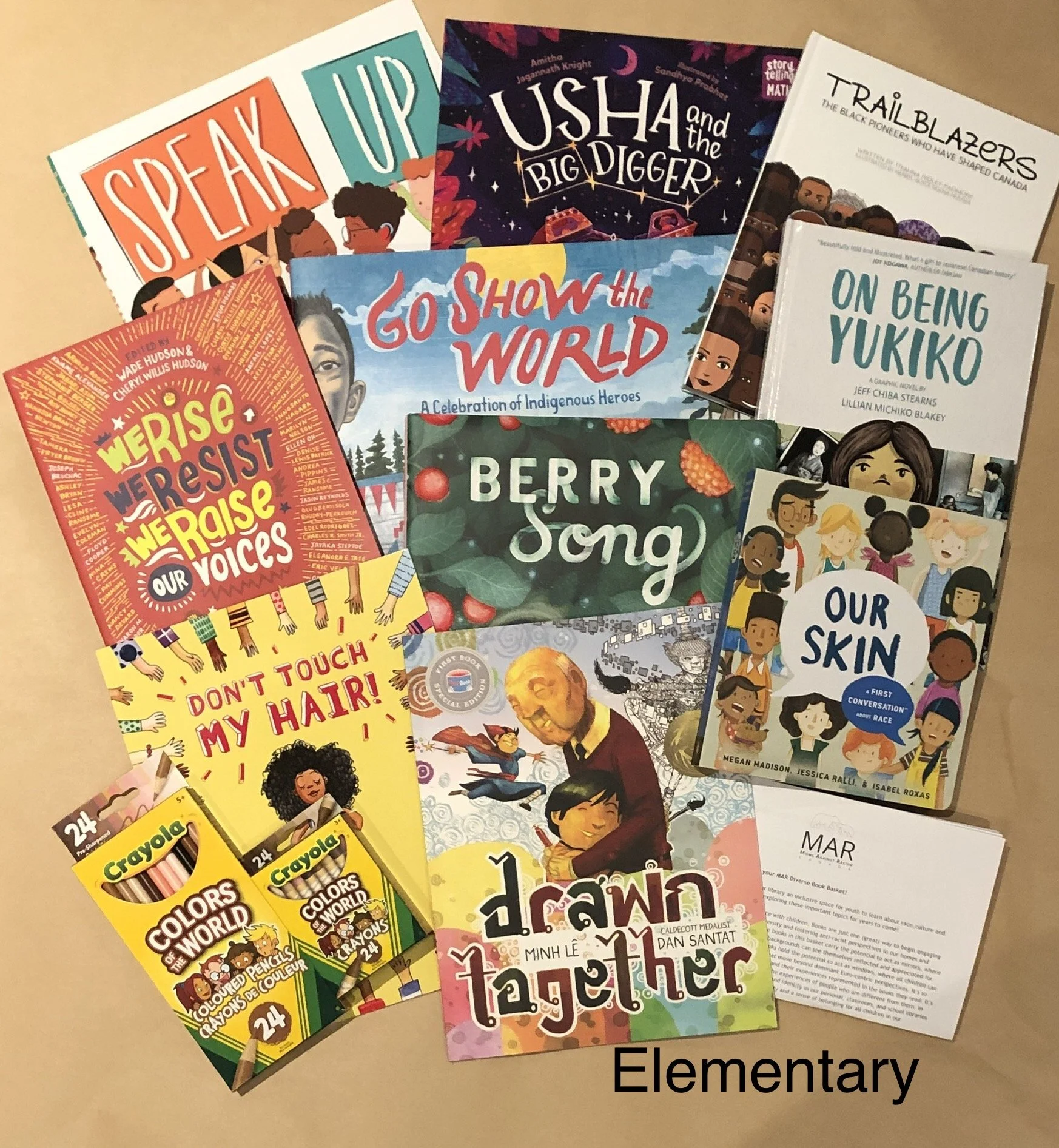
One of the initiatives of MAR is the Diverse Book Baskets program. Created by their Education Advocacy Team, these baskets contain ten carefully curated books that reflect racial, cultural, gender diversity. They are sent to families, classrooms, libraries, and community centres across Canada, making representation accessible and visible in the spaces where children grow.
“When kids see themselves in stories, they feel like they matter,” Kerry said. “And when white kids read stories with racialized heroes, it expands their empathy and understanding.”
In addition to Diverse Book Baskets, MAR also hosts MAR Talks, a series of conversations featuring BIPOC thought leaders and subject-matter experts. These talks range across a variety of topics, each intersecting with anti-racism, identity, and lived experiences.
But what keeps MAR’s work consistent are its core values: community, courageous action, healing, humility, learning and unlearning. These values are actively modeled in leadership, in moderation of online spaces, in language choices, and in how volunteers engage with each other.
“Our board operates through shared leadership,” Kerry explained. “We’re trying to recreate the village, in a sense. We’ve become so disconnected from each other. MAR is about building that connection back.”
Kerry is also clear that anti-racism must go hand-in-hand with decolonization. And for her, decolonization starts with unlearning the ideas and power structures we’ve internalized.
“Decolonization is about asking, ‘Why is this like this, and who does it serve?’” she said. “It’s about recognizing how white supremacy, capitalism, and patriarchy have been baked into the way we even parent our children.”
“We are the first environment that our kids get socialized into those power hierarchies. So, we have to examine where our ideas came from, and whether they’re helping us or forcing us to disconnect from our authentic selves.”

That’s why MAR centers people in mothering roles not just biological mothers, but aunties, educators, caregivers, and anyone guiding a young person’s life. These are the people with the power to shape values, conversations, and choices at the ground level. And Kerry believes change can happen in a single generation if we’re willing to do the work.
To the next generation, Kerry has one core message:
“You are perfect just the way you are. You have power. You have agency. And when you feel grounded in your authentic self, there’s no need to oppress anyone else.”
That’s what MAR is building, a community where kids grow up empowered, where parents are supported in unlearning harmful systems, and where anti-racism becomes a lifelong, shared practice.
Looking ahead, the future of MAR is focused on deepening community and sustaining the work. A major step in that direction is their new community platform, launching today! This space will allow MAR to move off of Facebook into a dedicated, private environment designed specifically for healing, learning, and courageous dialogue.
“We’re really excited about it,” Kerry said. “We’re building something where people can show up, be human, and keep doing the work together.”
Join before June ends and receive a free month of membership. BIPOC members always join for free.
Visit Moms Against Racsim to learn more, request a Diverse Book Basket, sign up for upcoming MAR Talks, and become part of a growing community committed to raising the next generation with one conversation, and one courageous action at a time.
Written by: Bolade Afolabi